Fishermans Trail Portugal
10 stages of ◆Fishermans Trail Portugal◆ including accommodation & luggage | Difficulty: ▲▲▲△△
Fishermans Trail Portugal

10 stages | 12 days
Fishermans Trail Portugal
▸ 11 nights in hotels and apartments included, bed and breakfast basis.
▸ 10 walking stages from point to point, luggage transfers.
breakfast included
luggages transfers
stages between 14~22 Km. day
from February, 1st to November, 30th


full itinerary: 187,4 Km
total ascent: 3978 mts
total descent: 3972 mts
Customised app
Offline GPS navigation
Relevant information
STAGES | ACCOMMODATION:
arrival in Lisbon ↦ transfer to Porto Covo
- Optional private transfer from Lisbon to Porto Covo
- …or transfer on your own with

- 1st night in Porto Covo ▸Hotel Zé Inácio (or similar)
Porto Covo ▸ Vila Nova de Milfontes
Vila Nova de Milfontes ▸ Almograve
Almograve ▸ Zambujeira do Mar
Zambujeira do Mar ▸ Odeceixe
Odeceixe ▸ Aljezur
Aljezur ▸ Praia da Arrifana
Praia da Arrifana ▸ Carrapateira
Carrapateira ▸ Vila do Bispo
Vila do Bispo ▸ Sagres
Sagres ▸ Salema
departure day ↦ transfer to Faro or Lisbon
- Optional private departure transfer to Faro or Lisbon
- …or transfer on your own with
 or
or 


DIFFICULTY LEVEL
This programme is for you if you are in excellent physical condition; if you can cover steep slopes and have no vertigo or health problems; if you regularly do long walks and consider yourself a good sportsman, love nature and are respectful of the environment.
See more details at:
FREQUENTLY ASKED QUESTIONS
FLEXIBLE PROGRAMME: you can rearrange the stages in order to fit days off in between them. We adapt it to your wishes.
ATTENTION: The route in stages along the Fisherman Trail in Portugal requires good physical condition and walking safety. Only suitable for regular walkers.
Well-signposted trails & GPX tracks
luggage transfer from hotel to hotel
point to point walks

traslados de equipajes
we move your luggage from one accommodation to next so that you can walk lightly

accommodations
small charming hotels, with breakfast (more information in Hotels tab)

stages
10 stages of approx. 14 - 22 Km. each, to walk the best of Fishermans Trail Portugal

Further information …

FISHERMAN TRAIL: HISTORY
The southwestern region of Portugal, known as the Alentejo and Algarve, especially the Costa Vicentina, has historically been a sparsely populated area, mainly dedicated to agriculture, fishing and livestock farming. The coast remained relatively isolated for centuries, allowing it to preserve its unique biodiversity and almost untouched natural landscape.
For centuries, rural roads and fishermen’s trails connected small villages, cliffs and beaches, used by locals to access the sea, graze livestock or trade between villages. These trails, many of ancient origin, formed the basis of what would later become the Fisherman Trail.
At the beginning of the 21st century, the tourist and ecological value of this region began to be recognised. In 1995, with the creation of the Southwest Alentejo and Vicentine Coast Natural Park, conservation measures were established that limited urbanisation and promoted sustainable tourism.
However, it was in the 2000s that the idea emerged to create an official hiking trail that would take advantage of the old local paths, combining nature tourism, sustainable development and the economic revitalisation of rural communities.
The initiative came from the non-profit association Rota Vicentina Associação (founded in 2010), which brought together local actors: municipalities, rural tourism companies, environmental NGOs and local communities.
In 2012, the Rota Vicentina was officially inaugurated, with two main itineraries:
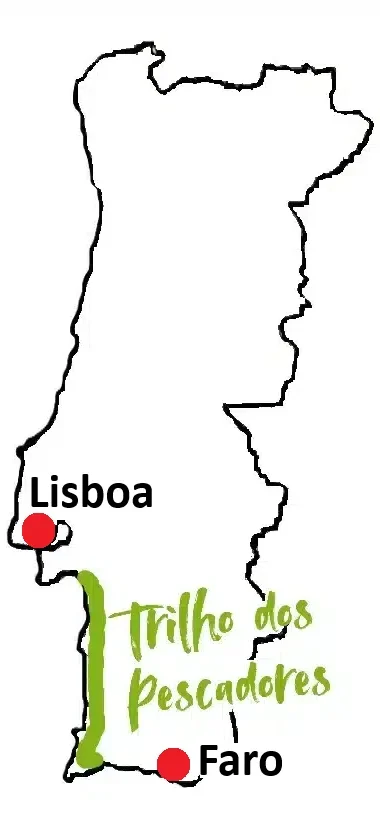
▸Trilho dos Pescadores (Fisherman Trail): following the coastline, along paths traditionally used by local fishermen.
▸Caminho Histórico (Historic Trail): an inland route connecting historic villages, rural and agricultural paths.
Both routes totalled more than 350 km of signposted trails, crossing the Alentejo and Algarve regions, from Santiago do Cacém to Cabo de São Vicente in Sagres.
Highlights of the trip:
Fisherman Trail: along the southwestern Portuguese coast
Fishing villages and hamlets with an Atlantic flavour
Stunning landscapes on a beautiful and unforgettable hiking trail
Fishermans Trail Portugal ▸ Rota Vicentina
In the southwestern corner of Europe, where the Portuguese land plunges into cliffs overlooking the Atlantic, a labyrinth of trails lay dormant among dunes, pine forests and fields of rockrose. These were the humble Fisherman Trail and shepherds, traced by centuries of anonymous footsteps, embroidering a rugged and luminous landscape marked by the salty wind and the constant murmur of the ocean. For generations, these fisherman trail served as secret threads linking small villages, hidden orchards and inaccessible coves, invisible to the outside world but vital to those who lived on the margins of land and sea.
With the arrival of the new millennium, winds of change blew. The Costa Vicentina, protected by its natural park since 1995, was already a sanctuary of biodiversity, but also a forgotten land, where young people were leaving and the roads were overgrown with weeds. It was then that a vision emerged: what if those humble trails, in their simplicity and wild beauty, could be the veins of a renaissance? A group of dreamers — farmers, rural hoteliers, nature guides, cultural managers — came together, not just to look out to sea, but to open their land to the world. Thus was born the idea of the Rota Vicentina, not as a simple fisherman trail, but as a living tapestry of memories, landscapes and hopes.

In 2012, after years of planning, signposting and dialogue with local communities, the route was inaugurated. It was not a road, but a return to the slow pace of walking, to a journey that breathes with the earth. Two main paths unfolded: the Fisherman Trail, which winds along the cliffs, skimming the waves and seagulls; and the Caminho Histórico, which heads inland, crossing fertile valleys, whitewashed houses and Roman ruins. Each step offered not only a landscape, but a story: that of the man who goes down every day to fish for barnacles on the rocks, that of the old woman who still harvests figs under the scorching sun, that of the mills that whisper legends to the wind.

The Fisherman Trail quickly attracted walkers from all corners of the world. They came in search of the authenticity of an unspoilt landscape, where the silence is broken only by the song of the curlews and the echo of the sea. But more than tourists, they were guests in a land that was learning to reveal itself without betraying its essence. With every hiker who walked its paths, new initiatives flourished: family accommodation, taverns serving fresh fish, basket weaving and pottery workshops. The route became a bridge between tradition and the future, between man and nature.
Today, more than ten years later, the Fisherman Trail continues to grow, not only in kilometres, but also in significance. It is a song to the simple land, a tribute to the paths that, when travelled, bring life back. And with every step, a reminder: that walking is not just about moving forward, but also about listening, contemplating, and belonging again.
Other similar adventures


Request a quote
Not exactly what you’re looking for?
We adapt to your requirements Tell us what you want and we’ll do a tailor-made plan for you.

We will get back to you as soon as possible.

…Frequently Asked Questions
What level of fitness do I need to complete these 10 stages?
A medium-high level of physical fitness is required. You will walk between 15-25 km per day for 10 consecutive days, with moderate elevation changes. It is advisable to have previously completed hikes of at least 4-5 hours and to be accustomed to walking for several days in a row.
When is the best time of year to do this route?
Spring (March to May) and autumn (September to November) are ideal, with mild temperatures between 15-25°C and flower-filled landscapes in spring. Avoid July-August due to extreme heat (which can exceed 35°C) and excessive numbers of tourists. Winter is feasible but with more rain and wind. In December and January, there is not enough accommodation available, making this route practically unfeasible due to the lack of adequate infrastructure.
What does a typical independent travel package include?
It usually includes: accommodation with breakfast for 10 nights, luggage transfer between stages, access to the GPS navigation app with downloadable maps, informative material about the route, 24/7 emergency telephone assistance and, sometimes, a welcome pack with physical maps.
How exactly does the luggage transfer service work?
Every morning, leave your suitcase at your accommodation before you leave (usually before 9:00-9:30 a.m.). The transfer company will pick it up and take it to your next accommodation, where it will be waiting for you when you arrive in the afternoon. You only need to carry a small rucksack with your essentials for the day. It is important to label your luggage with your name to avoid confusion. We provide label tags that you will find at your first accommodation upon arrival.
What is the maximum weight my suitcase can weigh for transport?
The limit is generally 15-20 kg per suitcase. It is advisable to bring a suitcase with wheels or a medium-sized travel rucksack.
Is it easy to get lost along the route? Is it well signposted?
The Rota Vicentina is reasonably well signposted with blue and green markings (depending on the trail), but some sections may have poor signage. The GPS app is essential in these cases, as it shows your exact position in real time and alerts you if you stray off course.
Do I need previous experience with GPS navigation apps?
No, the NATOUR app is very intuitive. Before starting your route, spend 30 minutes familiarising yourself with the application: how to download offline maps, how to follow the track, how to activate detour alerts. We include video tutorials.
What if I don't have mobile signal during the walk?
The app works with GPS, which does not require an internet connection once the maps have been downloaded. However, in some remote areas of Alentejo, mobile coverage may be poor. Always carry a paper map as a backup and an external battery for your phone.
What type of accommodation will I have during the route?
Normalmente pequeños hoteles rurales, casas de huéspedes (guesthouses), hostales familiares o bed & breakfasts. En pueblos más pequeños puede haber opciones más básicas pero limpias y acogedoras. Raramente son hoteles de cadena.
Are meals included in addition to breakfast?
Generally, only breakfast is included. You will need to organise your own lunches (often a picnic that you prepare in the morning) and dinners. Many villages have restaurants where you can try local Portuguese cuisine, although some sections pass through areas with few options.
Are there any shops or restaurants along the way to buy food?
Not always. Some stages pass through rural areas without services for 15-20 km. It is essential to set off each morning with plenty of water (1.5-2 litres) and enough food for the day: nuts, sandwiches, fruit, energy bars.
Do I need trekking poles?
They are not essential but highly recommended. They help distribute effort, reduce the load on knees and ankles when going downhill, and provide stability on uneven or sandy terrain. Especially useful if you are overweight or have joint problems.
Is it possible to shorten stages if I feel tired or have problems?
Yes, in most cases. You can contact our assistance service and we will arrange transport for you to the next stop. There are also towns along the way where you can hail a taxi. It is important to have some cash on hand for these emergencies.
Is it safe to walk alone on this route?
Yes, Portugal is a very safe country. However, on lonely stretches along cliffs or in remote areas, it is preferable to be accompanied or at least inform someone of your daily route. The main risks are falls, sprains or sunstroke, not public safety issues.
How do I get to Porto Covo to start, and how do I return from Salema?
To get to Porto Covo:
- 1. Fly to Lisbon
- 2. Take a taxi from the airport to the Sete Rios bus station (Lisbon)
- 3. Take the Rede Expresso bus to Sines (3 hours) and from there to Porto Covo (20 minutes).
Return from Salema
- 1. Vamus bus to Lagos or Faro
- 2. Rede Expresso bus to Lisbon or Faro
We can also offer private transfers to and from Lisbon or Faro airports, which greatly simplifies logistics. However, private transfers are quite expensive. Please ask us for more information.
What options do I have if I want to walk with someone but am travelling alone?
Some apps, such as GAFFL, make it easy to connect with other independent hikers. There are also forums and Facebook groups dedicated to the Rota Vicentina where people travelling alone can find fellow travellers to share expenses and experiences with. Accommodation usually offers single or shared rooms, depending on your preference. Sharing the trip with someone else has many advantages:
- Financial savings: When travelling with a partner or friends, the total cost is significantly reduced as double rooms offer a better rate per person and you can share expenses such as taxis or transfers.
- Reduced ecological impact: Each additional traveller who shares services reduces the carbon footprint of the journey, making your adventure more respectful of the natural environment.
- Personal enrichment: Living this experience with others multiplies the memorable moments, allows you to exchange impressions of the landscape and creates special bonds in a unique environment.
When and how will I access my itinerary details?
Two weeks before departure, after final payment for the trip, you will receive an email with instructions for the app, your personal passwords, booking confirmations, and advice on equipment. When you check in on your first night, your accommodation will provide you with a kit containing a paper map and the necessary labels to identify your luggage during transfers.
What exactly is included when I book a self-guided trip with NATOUR?
NATOUR builds your self-guided trip around three essential services that allow you to walk with complete confidence:
- Complete logistics: confirmed reservations at each stage’s accommodation; daily luggage transport between different accommodations; passenger transfers when necessary.
- Technology at your fingertips: our own app with downloadable maps, offline GPS and descriptions of relevant points along your route.
- Continuous support: 24/7 helpline available for any queries or emergencies.
-
Destination
Our gallery
Pictures from the stages


Day 1
Arrival in Lisbon
Optional private transfer to Porto Covo, or transfer by bus on your own with (Lisbon Sete Rios).
Day 2
1st stage: Porto Covo ▸ Vila Nova de Milfontes
We start our first stage in Porto Covo. Today, we will pass countless beaches and small bays, but also some cliffs along the way. The sea, which will be our companion for the next few days, presents itself in all its beauty and power.
 19,2 km | ↗ 163 m | ↘ 164 m
Day 3
 2nd stage: Vila Nova de Milfontes ▸ Almograve
Today's stage will be a little more relaxed. We start directly at the ferry pier and cross the River Mira (€5/person). On the other side of the river, we first walk through some fields and meadows until we reach the sea again and continue our way parallel to the coast.
 15,1 km | ↗ 162 m | ↘ 161 m
Day 4
 3rd stage: Almograve ▸ Zambujeira do Mar
On today's stage, we will once again enjoy magnificent views. A beautiful dune landscape awaits us and we may even have the opportunity to see a few stork nests on the cliffs and high rocks. We first circle around the village of Almograve before heading towards the sea and south along the coastline.
18,8 km | ↗ 198 m | ↘ 197 m
Day 5
 4th stage: Zambujeira do Mar ▸ Odeceixe
Today's stage takes us to Odeceixe and along a very beautiful path to Odeceixe beach. We pass some impressive bays, walk through a dune landscape and a small forest, cross wooden walkways directly by the sea and pass an animal enclosure.
21,5 km | ↗ 338 m | ↘ 336 m
Day 6
 5th stage: Odeceixe ▸ Aljezur
Today's stage takes us along the Algarve coast. We start in the pretty village and walk along the River Seixe until we reach the coast and head south.
19,6 km | ↗ 226 m | ↘ 236 m
Day 7
 6th stage: Aljezur ▸ Praia da Arrifana
The next stage of the Trilho dos Pescadores crosses the historic centre of Aljezur, descending towards the agricultural valley where small vegetable gardens follow one another until reaching the coastal area.
16,6 km | ↗ 300 m | ↘ 253 m
Day 8
 7th stage: Praia da Arrifana ▸ Carrapateira
On today's stage, the cliffs reach heights of up to 100 metres in places. We start in the village and hike inland through diverse vegetation. The trail leads through fertile valleys where all kinds of vegetables used to be grown, fertilised with seaweed collected from the sea.
19,6 km | ↗ 273 m | ↘ 319 m
Day 9
 8th stage: Carrapateira ▸ Vila do Bispo
Today you can look forward to breathtaking views and spectacular rock formations alongside secluded beaches with pristine sand. A journey through the true jewel of Atlantic nature.
17,2 km | ↗ 363 m | ↘ 293 m
Day 10
 9th stage: Vila do Bispo ▸ Sagres
Today's tour takes us to Sagres, back to the coast and on to Cabo de São Vicente, the southwesternmost point of Europe. First, we pass the Torre de Aspa and a little later the headland Ponta do Telheiro and the beach of the same name.
20,6 km | ↗ 213 m | ↘ 272 m
Day 11
 10th stage: Sagres ▸ Salema
The last stage of the Trilho dos Pescadores runs along the coast, up and down, past impressive limestone cliffs with unique shapes, and ends in Salema, a fishing village that takes its name from a tasty fish native to these waters: the salema.
19,4 km | ↗ 339 m | ↘ 362 m
Day 12
Departure or extension
Optional private transfer with or transfer on your own with to Faro or Lisbon airport, or possible extension of your stay in Portugal. TOUR LOCATION
Explore the best of the Fishermans Trail Portugal in 10 stages (12 days)


ACCOMMODATION
Subject to availability:
PORTO COVO ▸ Hotel Zé Inácio (or similar)


VILA NOVA DE MILFONTES ▸ The Blue Bamboo Hotel (or similar)


ALMOGRAVE ▸ Fishermans House (or similar)


ZAMBUJEIRA DO MAR ▸ Casa Azul (or similar)


ODECEIXE ▸ Casa Dorita (or similar)


ALJEZUR ▸ Hotel Vicentina (or similar)


PRAIA DA ARRIFANA ▸ Hotel Utopia (or similar)


CARRAPATEIRA ▸ Hotel Casa Fajarda (or similar)


VILA DO BISPO ▸ Hotel Mira Sagres (or similar)


SAGRES ▸ Mareta Beach B&B (or similar)


SALEMA ▸Hotel Residencial Salema (or similar)


Additional overnights
It is also possible to book some additional days, before or after the hiking week, or an additional week to relax.
Difficulty
To successfully achieve the 10 stages of Fisherman Trail it is necessary an excellent physical condition and steady walk. According to the year season, temperatures can be extreme (hot and/or cold). Therefore, it is necessary to have suitable warm clothes permanently, to be removed as layers if necessary. Some parts of this trail include passages with slippery loose stone. Although most of this trail is roomy enough, certain sections are quite aerial and require caution. Using hiking poles is highly recommended.
Trails
The Rota Vicentina is a well signposted network of trails. All sections where from our tours are perfectly marked. You will get from us precise indications of each route and assistance from the hotline on your walks.
We recommend
Appropriate hiking clothing and sturdy footwear. During the tours, it is necessary to have food and drink enough, as well as sun protection, a cap, wind jacket and, in the winter months, warm clothing.
Luggage transfer
We move your luggage from one accommodation to next, so on your hikes you should only carry a backpack with the essentials of the day. For the whole trip, it is recommendable to use a single suitcase, not bigger than 20 kg.
You can book at any date!
However, bear in mind that in the middle months of summer the heat can be intense.
FLY TO LISBON
...RETURN FROM FARO

Other options to consider
The Portuguese airline TAP also connects some UK airports with LISBOA o FARO. It is worth comparing prices and analysing all the possibilities 😉

FLY TO LISBON
...RETURN FROM FARO
Other options to consider
The Portuguese airline TAP also connects some UK airports with LISBOA o FARO. It is worth comparing prices and analysing all the possibilities 😉
...or search directly among airlines


Alberto
Travel organisation
Do you have any questions? I am happy to help you. I will answer any questions you may have!

Book early! ...and get a 6% discount for bookings more than 90 days in advance, for your trip between September 15th and June 15th
PRICES, valid until 31 October 2026
(NOT bookable between December and January)
1045 € ▸ 985 € per person in double/twin room (2 persons)
| Single Suplement (room for single use)
(...and 3rd person): + 495 €
Solo Traveller (1 person): 1898 € ▸ 1785 €
 Peak Tourist Season does not only mean high temperatures, crowded beaches and expensive flights. Accommodation prices also increase substantially. Therefore, during this period we are unable to offer early booking discounts and the price of the entire package may be higher than indicated. Portugal's peak tourist season begins on June, 1st and ends on September, 30th.
 Any arrival date is possible - You decide your travel dates and when to start. However, we must first request availability to the accommodations.
 Booking: With an initial payment of 150 € (per person), book now, guarantee your trip and pay the balance 21 days before arrival. We will confirm your reserve within 24 hours. But in the case of accommodations unavailability, we will refund the paid amount or propose alternative dates.
What does this programme include?
 Accommodations - 11 nights in different small charming hotels or apartments, B&B basis
 Informations - personalised information by video-talk (if desired) on your arrival day
 Descriptions & GPX Tracks - to follow the walks on your mobile device
 Luggage transfers - we move your luggage from accommodation to accommodation while you walk
 Support 24h - we keep permanently in touch with you throughout your stay to solve any problem or enquiry you may have

What is NOT included?
▸Flights to and from your home city to Portugal are not included
▸Transfer on arrival day to the starting point and transfer to the airport on departure day: see bus timetables at or with or private transfer with
▸Lunches & Dinners
Cancellation Policy
call us on +34 922 433 001 or text us at