
28 May Hiking the Cami de Cavalls at your own pace
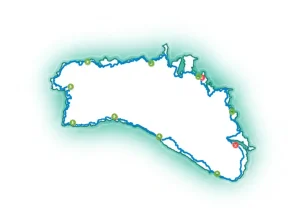
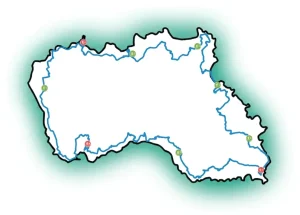
If you are looking for a self-guided walking holiday that combines natural experience with comfort, you will find one of the most rewarding routes in the Mediterranean here. The path circles the island over around 185 kilometres, passing through dune fields, sea cliffs, pine forests, dry-stone wall landscapes and small cala coves. Planned as a self-guided trip, the Cami de Cavalls really comes into its own, because stage lengths, accommodation and pace can be easily adjusted to suit your fitness level and the time of year.
Why the self-guided Cami de Cavalls works so well
 Not every multi-day walk lends itself equally well to an independent trip. On Menorca, the combination of waymarking, infrastructure and landscape density is particularly well suited. The route is divided into official sections and is generally well marked. At the same time, the experience remains surprisingly unspoilt, because many coastal stretches are car-free and give a sense of openness even during busy travel periods.
There is also an important practical advantage: the island is manageable in size. Transfers between stage overnight stops are easy to organise, and even a shortened tour delivers a complete and satisfying experience. Those who do not want to walk the full circuit can focus on the most beautiful or appropriately challenging sections without feeling they have settled for second best.
For many walkers this is exactly the appeal: being free on the trail without having to study maps every evening, carry heavy luggage or improvise taxi rides. A well-organised self-guided trip removes that friction from the experience without taking away the independence of the journey.
Which stages of the self-guided Cami de Cavalls are especially rewarding
Menorca has two faces, and that is precisely what makes the circuit so compelling. The north is wilder, more barren and often rougher. Reddish earth, open horizons, more dramatically sculpted coastal forms and wind-exposed sections dominate here. The south feels softer, greener and more typically Mediterranean in many places, with open pine woodland and those bright turquoise coves for which Menorca is famous.
Those who prefer more dramatic scenery will often feel more at home in the north. Stages around Favàritx, Cavalleria or Binimel-là combine geological contrasts with long sightlines across the sea. These sections tend to be slightly more demanding, as the ground is stonier and sun and wind can be more intense.
The south suits walkers who want to enjoy a relaxed pace while still experiencing genuine coastal character. Between Cala Galdana, Son Saura, Cala en Turqueta and Binigaus, shadier stretches, easy coastal paths and swimming coves alternate throughout the day. Technically, many southern stages are easier, though heat in midsummer should not be underestimated.
The full circuit is appealing, but it is not the best choice for every trip. Those with 7 to 10 days often do better with a carefully curated selection. This leaves room for transfers, arrival and the occasional half rest day. This is exactly where a well-planned trip shows its strength: it is not about maximum kilometres, but about a well-rounded overall experience.
Who the route suits – and who it might not
The Cami de Cavalls is not an alpine long-distance trail, but it is also not a simple stroll along the sea. Most stages require sure-footedness on uneven terrain, a solid base fitness and a willingness to be out in sun and wind for several hours at a time. Long, steep climbs are the exception rather than the rule, but the constant ups and downs along the coast do add up.
The route is well suited to experienced walkers who can comfortably manage day stages of around 12 to 22 kilometres. Active couples or groups of friends looking for their first multi-day coastal walk will also be well placed here. It is less suited to those who expect long distances on perfectly surfaced paths every day, or who are very sensitive to heat and can only travel in midsummer.
A further consideration is expectations around solitude. Menorca is quieter than many other Mediterranean islands, but some coves and towns are well visited during holiday periods. Those looking for complete solitude should think carefully about travel timing and stage selection. Outside the main season, the island feels considerably more peaceful.
Best time of year for the self-guided Cami de Cavalls
Spring and autumn are generally the most pleasant times. From March to June, Menorca is often green, flowering and fresh, with good temperatures for longer walking days. September, October and frequently November also offer excellent conditions, when the sea is still warm and the summer heat has eased.
Midsummer has one clear advantage: long days and the almost irresistible temptation to stop for a swim. At the same time, it is the most tiring time to walk. Open coastal sections with no shade, high temperatures and busier places can significantly diminish the enjoyment. Those walking in July or August should choose shorter stages, start early and treat the trip more as a walking and swimming holiday.
Winter on Menorca is quiet and atmospheric, but more changeable. Wind, rain and a rougher sea are more realistic possibilities to plan around. For experienced walkers this can be appealing, though not every accommodation and service will be available in the same way.
Organisation: what really makes an independent trip easier
On island routes in particular, the difference between organising everything yourself and being well prepared becomes apparent very quickly. In theory, everything can be booked independently. In practice, finding suitable accommodation, sensible stage transitions and reliable transfers often takes considerably more time than expected. Added to this is the question of how to move luggage when your start and end points are not the same.
A professionally prepared self-guided trip solves exactly these points. This typically includes pre-booked accommodation, often with breakfast, luggage transfer between stage overnight stops, carefully selected route descriptions and GPS data, and supplementary transfers where needed. That may sound straightforward, but on the ground it makes a real difference. Instead of thinking about logistics, you focus on the path, the weather and the landscape.
In our view, this level of comfort is particularly worthwhile on the Cami de Cavalls, because the island has so many beautiful but scattered stage overnight stops. Good trip planning ensures that the finest coastal sections and the most pleasant places to stay come together naturally. NATOUR builds exactly this balance between independence and organisational support into its trips.
Common planning mistakes
The most frequent mistake is underestimating Menorca. Because the island looks small, stages are sometimes set too long. But coastal paths take time, especially with photo stops, swimming breaks and warm weather. Fewer kilometres often means a better quality trip here.
Footwear choices are also sometimes taken too lightly. Sandals are ideal for beach breaks, but not for longer rocky sections. Light hiking shoes or grippy trail running shoes are generally the better choice. Sun protection, enough water and an early start in warm weather are equally important.
A further issue is misplaced priorities. Some walkers are determined to complete the full circuit even when half the island in the same time would be more relaxed and more enjoyable. On the self-guided Cami de Cavalls, completeness is not the measure of success – the right dramaturgy of the trip is.
What the route feels like on the ground
The special appeal of the Cami de Cavalls lies not just in individual highlights, but in the rhythm of walking. A lighthouse in the distance, then a quiet stretch through maquis scrubland, then a surprising view down into an almost Caribbean-looking cove – and at the end of the day, a place where dinner and a shower are already waiting for you. It is exactly this blend of movement, nature and comfort that makes the route so popular.
There is plenty of room for personal touches along the way. Keen photographers will find different subjects in the north than in the south. Those who want to swim plan consciously shorter stages. More sporty walkers can extend individual days or combine two sections. The route is flexible enough for different travel styles, as long as the planning stays realistic.
If you want to take on the Cami de Cavalls as a self-guided trip, think less in terms of as many kilometres as possible and more in terms of good walking days. Menorca does not reward rushing – it rewards attention: to coastlines, to changing light, to small paths, and to the pleasant feeling that everything essential has already been prepared for you along the way.
 You might also be interested in:
 86,2 km ·
  6 Stages ·
  8 Days