26 Jul Canary Islands or Azores Hiking – Which Suits You Better?
Canary Islands or Azores for hiking — it is the question many active travellers ask when choosing an Atlantic island for their next walking holiday. Both archipelagos are among the most exciting hiking destinations in Europe, both sit in the Atlantic, both are volcanic in origin. And yet the experiences could hardly be more different. Knowing the differences means choosing more accurately — and coming home with better memories.
Canary Islands or Azores hiking – the fundamental difference
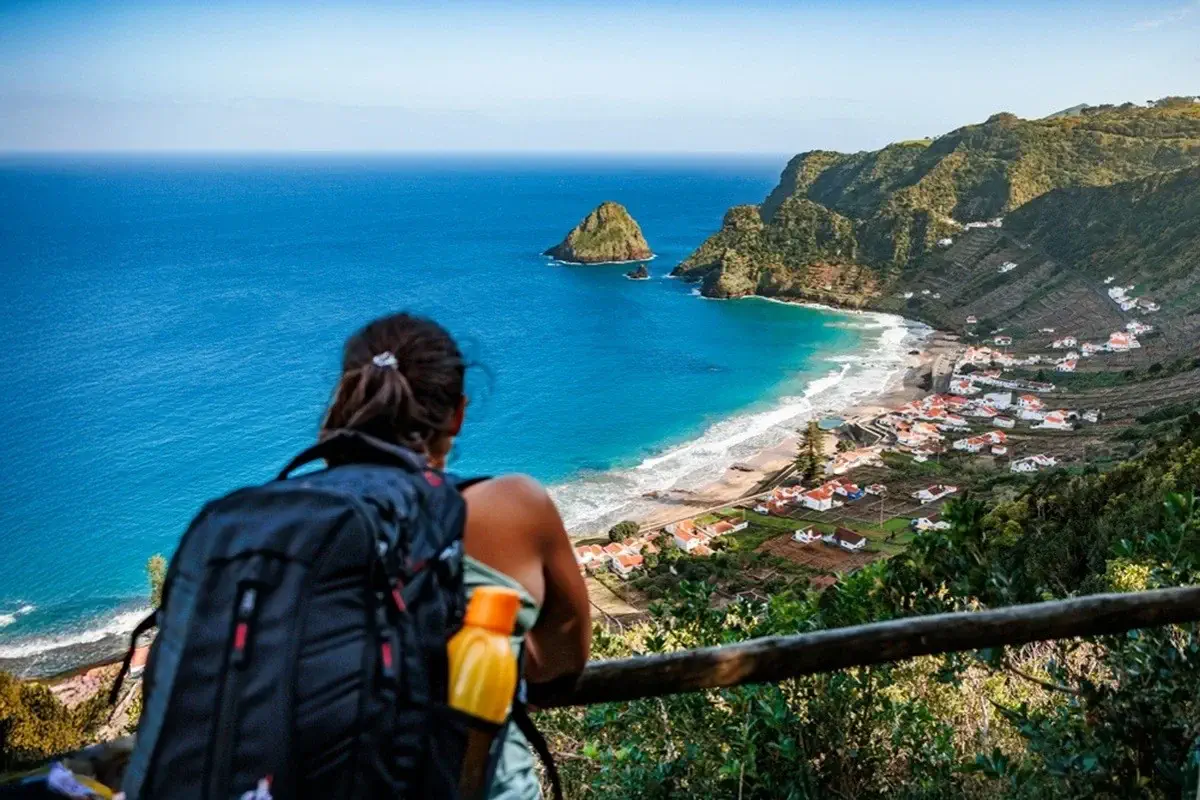
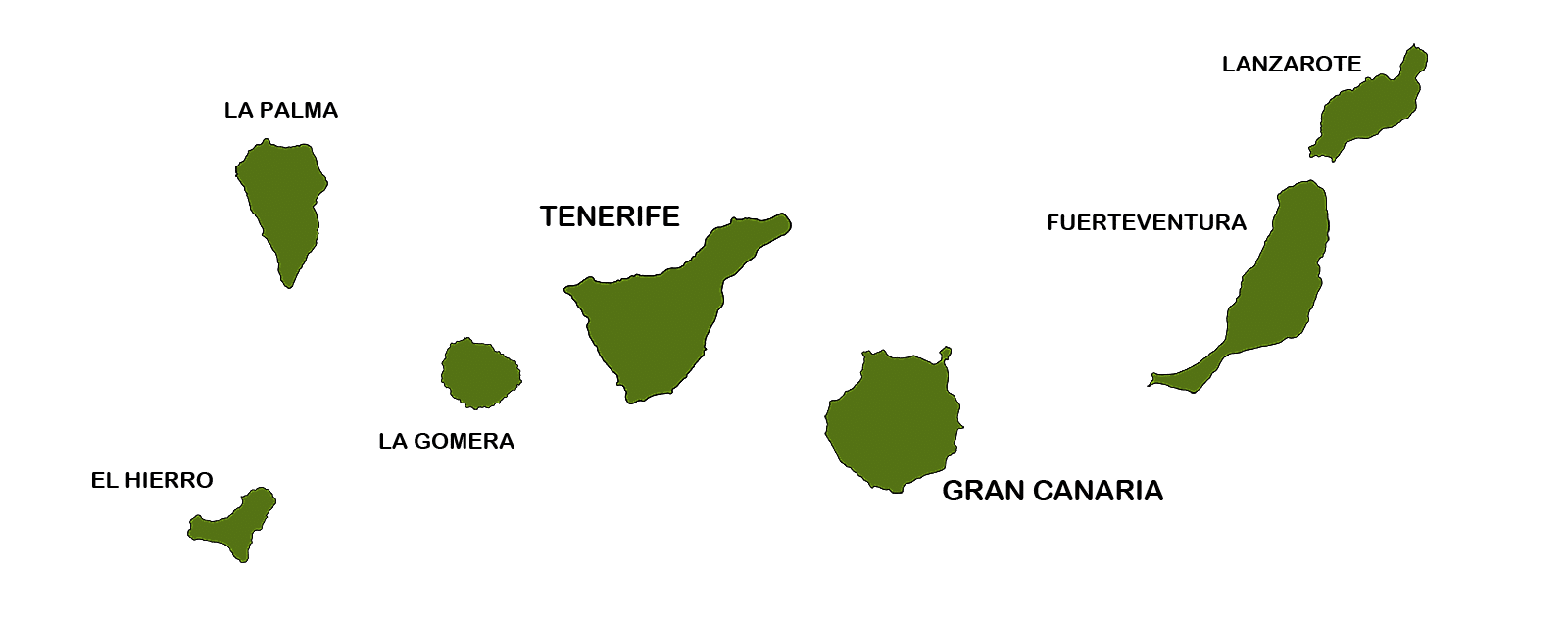
The Canary Islands are the destination of reliability: stable temperatures between 16 and 24 degrees almost year-round, sun-sure winter months and an enormous scenic range from lava deserts through pine forests to misty laurel woodland. Seven islands, each with its own character, connected by the long-distance trail GR 131.
The Azores are the destination of unspoilt nature: nine green islands in the middle of the Atlantic, crater lakes, hydrangea hedges, steaming hot springs and vegetation that recalls Ireland or New Zealand rather than southern Europe. The weather is more changeable, but the landscape has an intensity of green that on the Canaries exists only in the cloud-forest zones.
In short: the Canaries offer predictability and variety, the Azores atmosphere and seclusion. Both are magnificent — but for different types of traveller.
Hiking in the Canary Islands: variety and winter sun

The Canary Islands are Europe’s strongest hiking destination for the months of October to April. While trails in central and northern Europe are wet and dark, here you walk in pleasant temperatures over volcanic ridges, through barrancos and along coastal paths.
The centrepiece is the GR 131, which crosses all seven islands in independent sections — around 75 to 102 km per island in 6 stages over 8 days. Each island has a completely distinct profile:
La Palma is the sportiest choice: the Ruta de los Volcanes, the Caldera de Taburiente and over 5,000 metres of cumulative ascent on the full route make it the destination for fit, experienced hikers.
La Gomera is the most compact: cloud forest in the Garajonay National Park, deep ravines and ancient royal paths within a small area — ideal for intensive stage hiking.
Tenerife and Gran Canaria offer the widest range of difficulty levels and the best infrastructure — good for anyone who values flexibility.
El Hierro, Lanzarote and Fuerteventura score with quietness, open space and volcanic rawness.
Hiking in the Azores: green wilderness in the Atlantic
The Azores are not a destination for guaranteed sunshine — they are a destination for natural experience. The climate is oceanic: mild all year, but changeable. Sun, mist and rain showers can follow one another within a single day. It is precisely this weather that makes the islands greener than almost anywhere else in Europe.
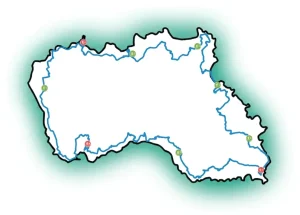
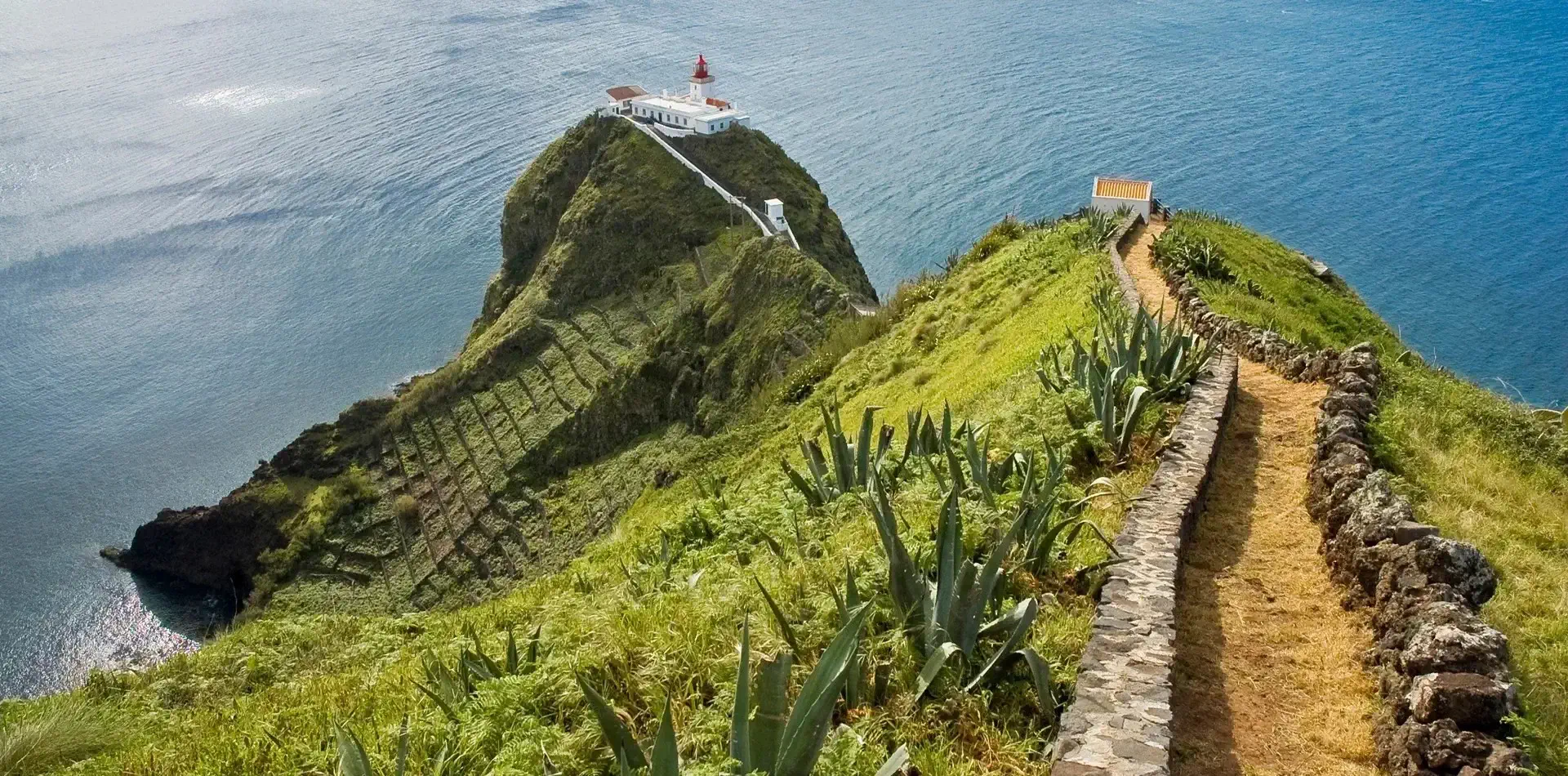
In the Azores, NATOUR offers the island of Santa María as a stage hike: 70 km in 5 stages over 8 days, once around the oldest island of the archipelago. Santa María is the sunniest and driest of the Azorean islands — a good compromise for anyone who wants the Azores experience with a little more weather security. Steep coastal slopes, green pastures, red earth and lonely bays define the route.
Then there is São Miguel, the main island, with its famous crater lakes of Sete Cidades and Lagoa do Fogo, hot springs and tea plantations — ideal as a combination or extension.
The Azores reward hikers who accept changing weather as part of the experience. Anyone who walks along flowering hydrangea paths in July, or watches steam rise from the thermal fields after a rain shower, understands why many call the Azores the “Hawaii of Europe”.
Direct comparison: Canary Islands or Azores hiking
Best time to travel
Canary Islands: October to April (possible year-round) · Azores: May to October
Weather reliability
Canary Islands: very high, sun-sure · Azores: changeable, oceanic
Landscape character
Canary Islands: volcanic and contrast-rich, from desert to cloud forest · Azores: consistently green, crater lakes, hot springs
Stage hiking
Canary Islands: GR 131 on 7 islands, 75–102 km per island · Azores: Santa María island circuit, 70 km
Difficulty
Canary Islands: easy to demanding, depending on the island · Azores: easy to moderate
Getting there
Canary Islands: many direct flights, 4–5 hours · Azores: fewer connections, usually via Lisbon
Atmosphere
Canary Islands: lively, good infrastructure · Azores: quiet, unspoilt, little tourism
Who should choose the Canary Islands?
Choose the Canaries if you want to travel in the winter half of the year — between October and April there is no more reliable hiking destination in Europe. Anyone looking for sporty stages with a real elevation profile is also better served on La Palma or La Gomera than on the gentler Azores.
The Canaries are also the right choice for anyone who wants variety: on one trip you can combine several islands, each with its own landscape character. And the infrastructure — direct flights, accommodation, transfers — makes the organisation considerably easier.
Who should choose the Azores?
Choose the Azores if you travel in the summer half of the year and want to escape the heat of the continent — while the Canaries can get hot in July and August, the Azores stay pleasantly mild. Anyone who puts quietness and unspoilt nature above everything else will find here a Europe that barely exists elsewhere anymore.
The Azores are the destination for hikers seeking green landscapes, crater lakes and Atlantic wildness — and who are happy to carry a rain jacket in the day pack in return. The Santa María island circuit is the ideal introduction: manageable stages, the sunniest island of the archipelago and the complete Azores feeling in one week.
Or both? The honest answer
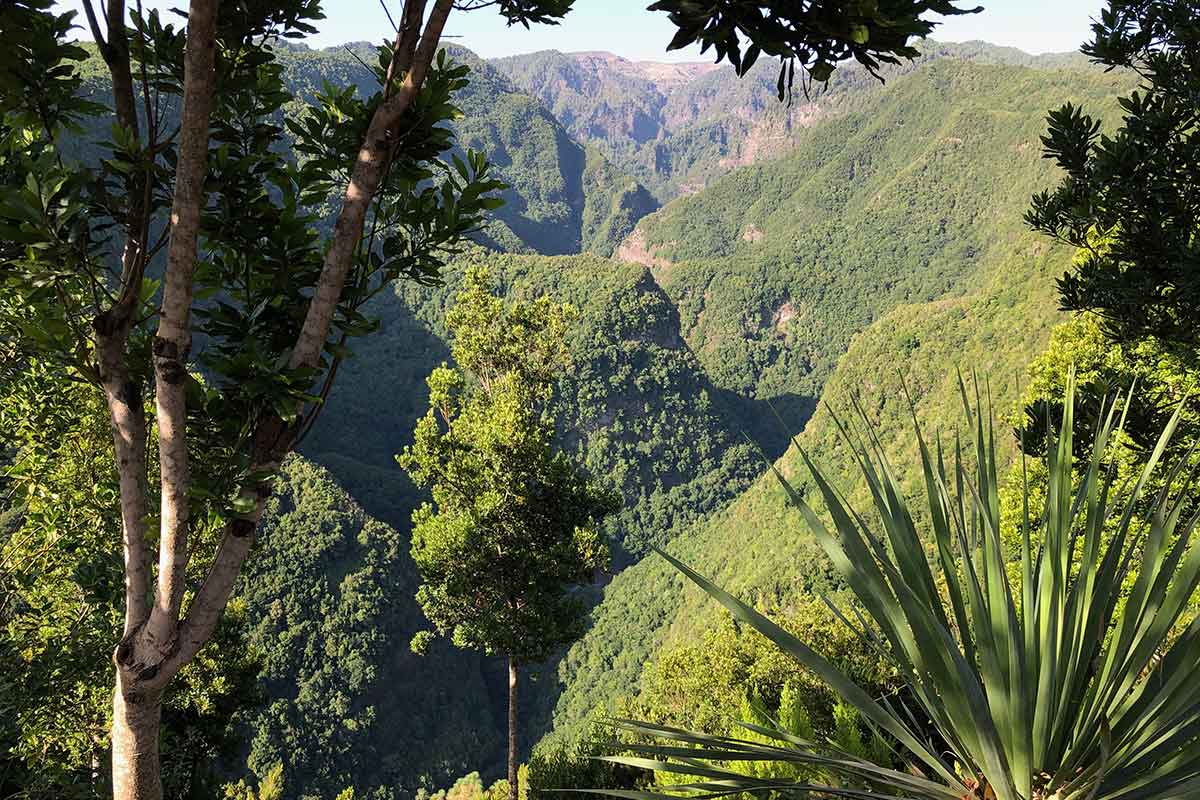
Many of our guests end up hiking both — just at different times of the year. The combination actually makes particular sense: Canary Islands in winter, Azores in summer. That way you use each archipelago at its best time and experience two completely different faces of Atlantic hiking.
Anyone who first walks the GR 131 on La Gomera and circles Santa María the following summer understands the Atlantic in a way a single trip cannot convey. It is not either-or — it is a sequence.
What NATOUR offers on both archipelagos
Whether Canary Islands or Azores: NATOUR organises both destinations on the same principle — as self-guided trips with pre-booked accommodation, luggage transfer from stage to stage, GPS data and local support. You hike independently and at your own pace; the logistics run in the background.
In the Canaries, the GR 131 is available on all seven islands, along with multi-island combination trips. In the Azores, the island circuit of Santa María. Both destinations benefit particularly from luggage transfer — in the Canaries because of the elevation gain, in the Azores because of the changeable weather, which makes dry spare clothing valuable.
Frequently asked questions: Canary Islands or Azores for hiking
Are the Azores or the Canary Islands better for a summer hiking trip?
For June to September, the Azores are usually the better choice. Temperatures stay mild while the Canaries can be hot on exposed volcanic stages. In return, expect changeable oceanic weather on the Azores — pack a rain jacket even in August. From October to April the recommendation reverses completely in favour of the Canaries.
Do I need previous long-distance hiking experience for either archipelago?
Not necessarily. The Santa María circuit in the Azores and islands like La Gomera or Gran Canaria are well suited to first-time stage hikers with reasonable fitness. Only the GR 131 on La Palma, with over 5,000 metres of cumulative ascent, is genuinely aimed at experienced multi-day hikers.
Which option is easier to reach from the UK or Ireland?
The Canary Islands, clearly. There are year-round direct flights from most British and Irish airports, taking around 4 to 4.5 hours. Reaching the Azores usually involves a connection in Lisbon, although seasonal direct flights to Ponta Delgada exist. Total journey time to Santa María is typically 6 to 9 hours.
Can I hike the GR 131 across all seven Canary Islands in one trip?
In theory yes, but it would take six to seven weeks. Most hikers pick one island per trip — 6 stages over 8 days — or combine two islands in a single holiday. La Gomera plus La Palma, or Tenerife plus La Gomera, are the most popular pairings thanks to short ferry connections.
How does the scenery actually differ between the two archipelagos?
The Canaries are landscapes of contrast: black lava fields, semi-desert, pine forest and cloud forest can all appear within a single stage. The Azores are consistently green — crater lakes, hydrangea-lined lanes, pastures and hot springs. If you want drama and variety, choose the Canaries; if you want lushness and stillness, choose the Azores.
Is luggage transfer available on both destinations?
Yes. On NATOUR self-guided trips in both the Canaries and the Azores, your main luggage is transported between accommodations every day, so you walk with only a light day pack. On the Azores this has an extra benefit: dry spare clothing waiting at the next hotel is worth a great deal in an oceanic climate.
 You might also be interested in:
 86,2 km ·
  6 Stages ·
  8 Days