07 Oct Underrated Hiking Routes on Menorca: The Complete Guide
Hiking routes on Menorca beyond the famous coves

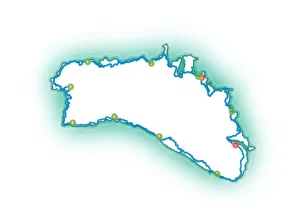
Anyone who only pictures Menorca’s famous coves between Cala Galdana and Cala Macarella is missing the island’s quieter side. Underrated hiking routes on Menorca cross wind-shaped limestone plateaus, pass through shaded ravines and reach stretches of coast where, even in high season, gulls outnumber beach towels. Many of these paths run along the Camí de Cavalls, the historic coastal trail that circles the island, yet they feel far less busy than the postcard-famous stages in the south.
These sections are particularly interesting for travellers planning a self-guided walking holiday: they combine well into day stages, offer varied landscapes, and show just how diverse Menorca is within a compact area. Realistic planning matters, though, since the terrain can be stony, exposed to sun and surprisingly slippery after rain. With the right stage lengths, transfers and reliable navigation, the island can be enjoyed at a relaxed, rewarding pace.
Why Menorca’s quieter paths are worth seeking out

The Camí de Cavalls is far from a uniform coastal trail. The north is dominated by dark rock, open pastureland and an often brisk breeze, while the south feels more sheltered, with pines, pale limestone cliffs and deeply cut barrancs. In between lie small harbours, dry-stone walls and the grazing fields typical of the island, whose gates walkers should always close carefully after passing through.
The lesser-known sections of these hiking routes on Menorca sometimes demand more attention than the popular cove walks, but in return they offer space, openness and a landscape that isn’t built for a quick photo stop. Experienced walkers in particular benefit from deliberately mixing well-known highlights with these calmer stages, much as they might on other islands such as the La Palma trails.
This variety packed into a small area is precisely what sets Menorca apart from many other Mediterranean destinations. Vegetation, rock and light shift within just a few kilometres, turning each stage into its own small adventure.
From Cala Morell to Punta Nati

West of Cala Morell, Menorca changes almost abruptly. Instead of lush vegetation, flat pale rock, low stone walls and old shepherd shelters define the terrain. The walk towards Punta Nati suits anyone drawn to bare coastal landscapes and the constant company of open sea.
The route isn’t technically difficult, but it is demanding under strong sun. Shade is scarce and the wind can pick up considerably. Late afternoon is when this stretch shows its best side, as the light highlights the texture of the dry-stone walls while the lighthouse stands watch over the rocky cape.
Plenty of water, a hat and a windproof layer are essential in the day pack. According to the Outdooractive hiking guide, exposed coastal routes like this one should always be tackled with sufficient fluids and sun protection.
From Es Grau to Cap de Favàritx
The route from Es Grau to the Favàritx lighthouse ranks among the most striking north-eastern stretches, yet it often sits in the shadow of the southern beaches. It links lagoon scenery, low dunes and an increasingly dark, almost lunar rocky coastline, offering a striking contrast to the pale limestone of the south.
The stage runs through open terrain and feels especially atmospheric in changeable weather. It shouldn’t be underestimated, though: the ground is uneven in places and there are only limited supply points between settlements.
Walking it in spring or autumn usually brings out the colours and tranquillity of this coastline most vividly. In high summer, an early start is well worth it to avoid the most exposed sections during peak heat.
From Favàritx to Arenal d’en Castell
South-west of the lighthouse, the Camí de Cavalls crosses a landscape where rock, small coves and open ground alternate. The stretch to Arenal d’en Castell is less dramatic in the classic sense than the lighthouse itself, but that’s exactly its appeal: it captures the rhythm of coastal walking on Menorca — walk, look, pause at a quiet cala, and move on.
This stage works well within a multi-day itinerary when accommodation in Arenal d’en Castell or an organised transfer is arranged. Length can vary depending on the chosen variant and access to the overnight stop, and GPS navigation helps keep walkers on course at junctions and less obvious coastal passages.
Through the Barranc d’Algendar and other inland stages
Not every great walk on Menorca has to hug the coast. The Barranc d’Algendar near Ferreries is a deeply cut valley with high limestone walls, denser vegetation and farmed land. After several sun-exposed coastal days, this route offers a welcome change of pace — shadier, greener and quieter.
The character of the walk depends on the chosen access and exit points. Some paths follow wider tracks, others narrower routes that can turn muddy after rain. Anyone drawn to geology, plant life and traces of traditional land use will find one of the island’s most varied sides here.
The stretch between Son Bou and Cala en Porter is often treated as a mere transfer route, yet it offers wide coastal views, pine-covered ground and a steady alternation between open terrain and sheltered passages. Inland lies the prehistoric settlement of Torre d’en Galmés, which can be worked into the route depending on planning.
On the south-east coast, the path between Binissafúller and Punta Prima runs past small holiday resorts, flat rocky coves and turquoise water, making it a good fit for an arrival or departure day when flight times and transfers allow. Travellers looking for similarly quiet stages elsewhere might also enjoy the trails of La Gomera.
Planning: turning quiet stages into a relaxed walking holiday
Menorca isn’t high-mountain terrain, but its paths still deserve respect. Many stretches are stony, markers can be obscured by vegetation or weather, and the sun has real strength even in spring. Sturdy hiking shoes with a good grip are far better suited than light casual trainers, along with at least a litre and a half to two litres of water per person, sun protection and an extra layer against wind.
The best time to walk is generally spring and autumn, when temperatures and light are pleasant, the landscape feels more vivid, and longer stages are easier to enjoy. In summer, early mornings remain the best option, while winter can be beautiful and peaceful on Menorca, though rain, wind and shorter days call for more careful planning.
On a multi-stage walk, logistics are often what determine comfort. Not every destination has accommodation right on the trail, and some starting points are hard to reach without a hire car or pre-arranged transfer. For route and terrain details, the Wikiloc trail database can also be a useful reference.
What NATOUR offers for hiking routes on Menorca
NATOUR designs itineraries along the Camí de Cavalls that thoughtfully combine quiet and well-known sections. This includes stage planning that accounts for changing landscapes, daily distances and personal fitness, plus accommodation arranged on or near the trail.
Luggage transfer brings real freedom: instead of carrying a heavy pack over rocky paths, walkers move with just a day bag and reach their prepared accommodation each evening. Transfers to start and end points are coordinated alongside detailed maps and GPS tracks, so even less obvious sections can be walked with confidence.
This keeps the focus exactly where it belongs: on the path, the coastline and the next glimpse of the sea. Travellers extending their trip may also enjoy the routes of the Azores or further afield in the Canary Islands.
Frequently asked questions about hiking routes on Menorca
What is the best season for hiking routes on Menorca?
Spring and autumn offer the most pleasant temperatures and the best light for longer stages.
Are the underrated Menorca paths technically demanding?
Most sections are moderate but require sure footing on stony or rocky ground.
How long are typical daily stages along the Camí de Cavalls?
Depending on the section and chosen variant, daily stages usually range from 10 to 20 kilometres.
Do you need a hire car for these hiking routes on Menorca?
A transfer is often useful for certain start or end points, as public transport is limited.
Is luggage transfer worthwhile for a multi-day trip on Menorca?
Yes, it makes walking with just a day pack much easier and adds real comfort along the way.
What gear is essential for the coastal paths?
Sturdy shoes, enough water, sun protection and a windproof layer are all essential.
Can quiet and well-known stages be combined on Menorca?
Yes, and doing so is highly recommended, as it reveals the island’s full range of landscapes.
Anyone who really wants to walk Menorca doesn’t need to plan every day around the most famous cove. Often it’s the stage between two well-known names that stays in the memory the longest.
 You might also be interested in:

 86,2 km ·
 6 Stages ·
 8 Days