
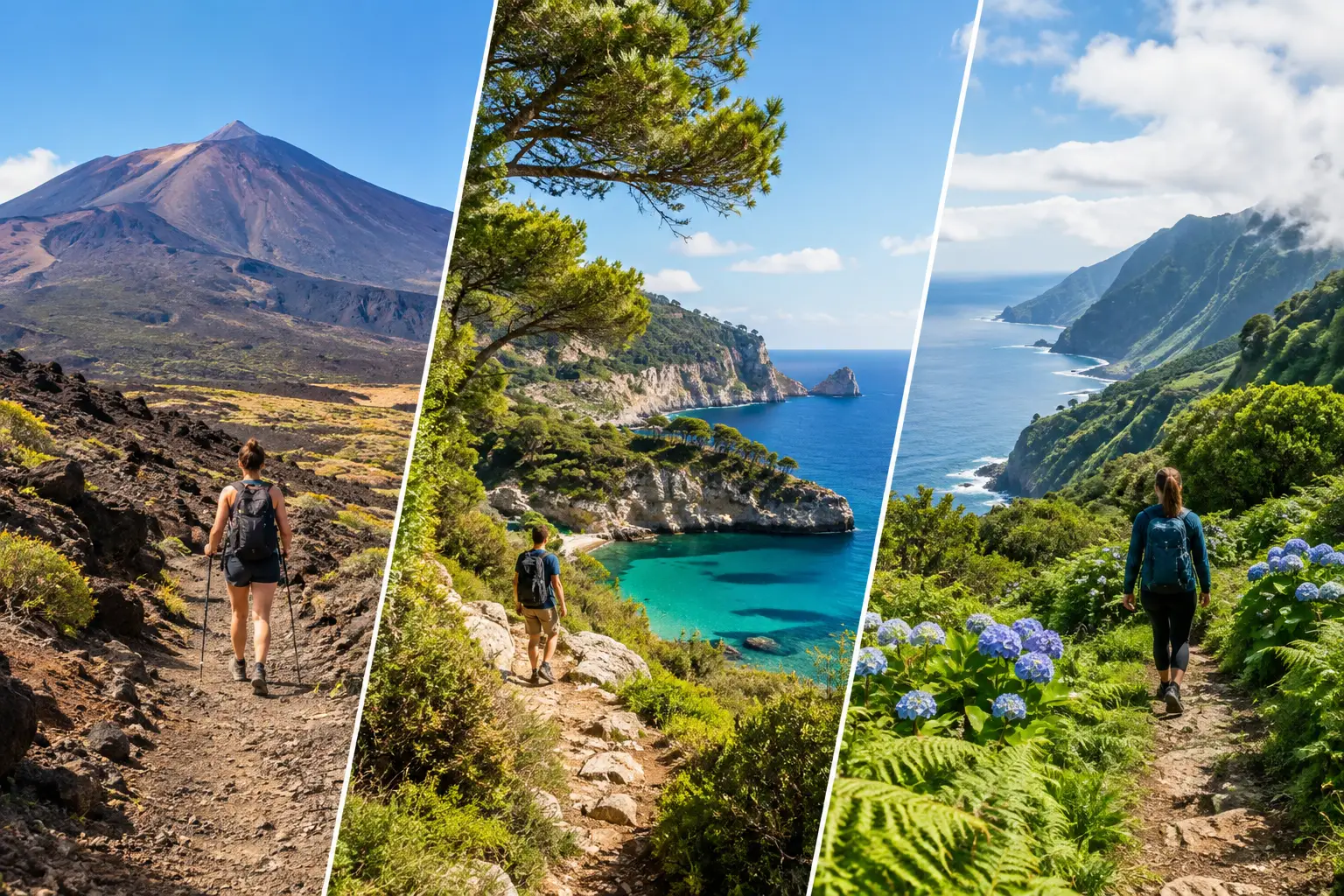
12 Sep Canary Islands or Balearics hiking – which fits better?
Black lava underfoot, trade wind clouds over the ridge, and the ocean far below – or perhaps dry stone paths, fragrant pines, and a quiet cove after the day’s stage? Those deciding between Canary Islands or Balearics hiking are not simply choosing between two archipelagos. Climate, trail character, season, and the preferred style of travel differ significantly.
Both destinations are excellent for self-guided walking holidays. Yet they suit different expectations. This comparison helps you make the right choice for your next stage-by-stage tour.
Canary Islands or Balearics hiking: the direct comparison
The Canary Islands are the right choice if you seek contrasting, often volcanic landscapes and routes with significant elevation profiles. On islands like La Gomera, La Palma, Tenerife, or Gran Canaria, laurel forests, barren crater landscapes, deep ravines, and scenic mountain ridges alternate within short distances. This makes stages varied but also demands sure-footedness, fitness, and a realistic view of elevation gain.
The Balearics feel different. Mallorca and Menorca also offer challenging walking days, but their rhythm is more Mediterranean. Dry stone walls, olive groves, limestone, coastal paths, and small villages shape the experience. On Mallorca, the Serra de Tramuntana can certainly challenge with long ascents and rocky passages. Menorca’s Camí de Cavalls is often more gently contoured, though not without substance: sun, wind, and longer coastal sections can make a day’s stage noticeable.
The most important difference lies in the terrain. On the Canaries, you often walk vertically: ascent from a valley, traverse of a ridge, descent to the next village. On the Balearics, hiking is more characterized by the interplay of coast, cultural landscape, and mountains. Those who enjoy scenic high-level routes and dramatic natural formations will find particularly strong hiking moments on the Canaries. Those who understand Mediterranean landscape, swimming stops, and refreshment options as part of the journey often find a better fit on the Balearics.
Climate and travel season for Canary Islands or Balearics hiking
For walking holidays, the Canary Islands are especially reliable from autumn to spring. Precisely when Central Europe is grey and cool, they offer mild temperatures and abundant light. However, weather changes do occur: higher elevations can be fresh, trade wind clouds bring moisture, and wind on exposed ridges is a factor to take seriously. This is not a disadvantage if you have the right clothing – rather, traversing several climate zones in one day is part of these islands’ appeal.
On the Balearics, the classic walking season is primarily spring and autumn. In March and April, many landscapes stand in lush green; in October and November, the sea remains pleasantly present. High summer, however, is only conditionally suitable for longer stages, especially on Menorca or in Mallorca’s lower regions. Shade is not always available, and midday heat transforms even moderate routes.
So if you want to hike in January, February, or during Easter holidays, the Canaries warrant particular consideration. For trips in April, May, September, or October, both archipelagos are attractive. Then personal preference decides: volcano and ridge path or limestone and Mediterranean.
For whom the Canary Islands are especially suitable
The Canary Islands are recommended for walkers who want not just to see landscape but to traverse it in its full diversity. A day might begin in cloud forest, lead over a ridge with wide Atlantic views, and end in a dry valley. These transitions make stage walks exceptional but require good tour planning.
The islands are particularly fitting if you enjoy hiking several consecutive days, travelling with changing accommodations, and are not bothered by longer ascents and descents. On marked long-distance trails or regional connections, routes emerge that go beyond single day excursions. They lead through island spaces whose character changes from stage to stage.
The challenge lies less in extreme technical difficulty than in the sum of elevation meters, surface, and weather. Scree descents, narrow paths, and volcanic rock require stable hiking boots. Those who dislike descents or have knee problems should carefully compare stage lengths and elevation profiles before booking. Shorter daily distances on the Canaries do not automatically mean an easy hiking day.
When the Balearics are the better choice
The Balearics are ideal when hiking and Mediterranean travel feeling are equally important. Arriving in a small village after a stage through the Tramuntana or along Menorca’s coast, enjoying local cuisine, and savouring the sea view are naturally part of the experience here. This does not make the journey less active, but differently paced.
Mallorca is interesting for sporty walkers who like mountains but appreciate well-developed infrastructure. The Serra de Tramuntana offers long, scenic routes with challenging elevation gain. At the same time, villages, accommodations, and supply options often lie within easily accessible distance. The stages can thus be very pleasantly combined into an individual walking week.
Menorca especially appeals to people who love coastal walking and prefer more even daily stages. The Camí de Cavalls follows the sea over large parts of the island, passing coves, pine forests, and open rocky landscape. The paths are not consistently flat, but the profile usually feels less alpine than on Mallorca or the more mountainous Canaries. However, sun and water supply should be taken seriously, as isolated coastal sections do not always offer spontaneous refreshment options.
Stage journey or base holiday – what works better for Canary Islands or Balearics hiking
This question is often more helpful than pure island comparison. The Canary Islands unfold their strength especially as a stage walking journey. By changing accommodation, you actually progress, experience different elevations, and see significantly more than from a fixed base. Luggage transfer makes this travel form comfortable: during the day you walk with a light daypack, in the evening your main luggage awaits at the next accommodation.
On the Balearics, both models work. A multi-day traverse or coastal walk brings you intensively closer to the island. A base holiday with selected day hikes can be equally sensible, for instance if you want more time for individual places, swimming breaks, or flexible rest days. On Mallorca, the decision depends strongly on whether the Tramuntana is central. On Menorca, the course of the Camí de Cavalls clearly favours a stage journey.
For both archipelagos: good navigation and reliable transfers determine whether a beautiful route becomes a relaxed holiday. Especially on linear routes, it is pleasant not to have to organize the return journey every evening. With individually planned trips from NATOUR, accommodations, luggage transfer, GPS navigation, and necessary transfers are coordinated so that attention remains where it belongs: on the path.
Key facts: Canary Islands or Balearics hiking
- Best travel time Canaries: October to April, year-round mild temperatures near coast, higher elevations can be cool
- Best travel time Balearics: March to May and September to November, high summer only conditionally suitable
- Terrain character Canaries: Volcanic, pronounced elevation profiles, transitions between climate zones, often steep ascents and descents
- Terrain character Balearics: Limestone, Mediterranean cultural landscape, coastal paths, alpine-influenced mountain routes on Mallorca’s Tramuntana
- Fitness: Canaries demand more elevation meters per day, Balearics offer more moderate stages (except Tramuntana)
- Infrastructure: Balearics more densely developed, more frequent refreshment options; Canaries more pristine, plan supply strategically
- Travel form: Canaries ideal for stage walking, Balearics also work as base holiday with day tours
The right choice according to your walking type
If you seek winter sun, enjoy elevation gain, and expect a new landscape each day, the Canaries are usually the more convincing choice. They are rougher, topographically more diverse, and on many routes more pristine. However, you should prepare for changing conditions and honestly assess your fitness.
If you plan a spring or autumn trip, value Mediterranean culture as much as nature, and enjoy combining coast with mountains, good reasons speak for the Balearics. Mallorca offers the more sporty mountain character, Menorca the quieter coastal rhythm. Those travelling with partners or friends who have different expectations of walking and relaxation often find a particularly good compromise there.
Do not let pictures alone determine your decision. Look at travel time, elevation meters per day, path condition, and how much variety you desire. Then the question Canary Islands or Balearics hiking becomes not a permanent either-or, but anticipation of precisely the island journey that now suits your time, your fitness, and your desire to be outdoors.
Frequently asked questions: Canary Islands or Balearics hiking
Which archipelago is better suited for beginners in stage walking?
The Balearics, especially Menorca, are more suitable for beginners. The stages are usually more even in profile, infrastructure denser, and supply planning simpler. On the Canaries, even less experienced walkers should choose shorter daily stages and prepare for significant elevation differences.
Can you combine Canary Islands or Balearics hiking with swimming?
This is significantly easier on the Balearics. Many stages on Menorca or along Mallorca’s coast lead directly past coves. On the Canaries, the focus is more on mountain and forest landscapes. Swimming opportunities exist but are less often part of the daily stage.
What equipment differs for Canary Islands or Balearics hiking?
On the Canaries, ankle-high hiking boots with good tread are important, plus layered clothing due to elevation changes. On the Balearics, lighter footwear often suffices, but sun protection and sufficient drinking water should be emphasized more. Trekking poles are helpful on both archipelagos for longer descents.
Are the Canary Islands or Balearics more hiker-friendly regarding waymarking and navigation?
Both regions have well-marked main routes. On the Canaries, long-distance trails like the GR 131 are consistently signposted, though smaller connecting paths can be less clear. On Mallorca and Menorca, waymarking of official long-distance trails is usually very reliable. GPS tracks are a sensible supplement in any case.
Is it worthwhile combining: first Canary Islands, then Balearics hiking?
Yes, if you have enough time. Both archipelagos offer different walking experiences that complement each other well. You could, for example, walk the Balearics in spring and switch to the Canaries in autumn or winter. This way you use the respective best travel time and get to know both landscape types in their full expression.
Further information and tour planning
Whether you choose the volcanic ridge paths of the Atlantic islands or the Mediterranean trails of the Mediterranean – careful preparation makes the difference. Pay attention to realistic stage lengths, suitable accommodations, and reliable information about the routes.
Detailed route descriptions, elevation profiles, and current information on path conditions and infrastructure can be found in the Outdooractive hiking guide. There you can filter tours by difficulty, duration, and region and get a more precise picture of the requirements before making your decision between Canaries and Balearics.